Astore Suite
Astore Suite is Accor Group’s B2B procurement platform used by hotels worldwide to connect with approved suppliers. The platform enables hotel teams to search suppliers, browse product categories, and access procurement data to support purchasing decisions.

Duration
6 months (2024-25)
Tech Stack



Summary
Astore Suite is Accor Group’s B2B procurement platform used by hotels worldwide to connect with approved suppliers. The platform enables hotel teams to search suppliers, browse product categories, and access procurement data to support purchasing decisions.
Sales teams were creating hundreds of tickets manually to request missing supplier information, which category managers then chased by email. Suppliers were not aware of the information published about them on the platform, and customers frequently complained that supplier profiles lacked transparency and reliability.
The mission was to clarify supplier data flows, improve onboarding and data accuracy, and deliver a scalable experience for buyers and suppliers across multiple markets. In parallel, I contributed to structuring a unified Design System to ensure interface consistency and accelerate product delivery across future procurement modules.
Project Overview
Role: Lead Product Designer
Team: Product Manager, Tech Lead, 4 Engineers, QA
Domain: B2B Procurement – Buyers & Suppliers
Responsibilities: Product strategy, stakeholder alignment, UX delivery
Methods: Discovery workshops, journey mapping, prototyping, usability testing
Problems identified
Supplier Data Quality Issues
Missing key supplier information (certifications, delivery zones, product categories, pricing models).
Inconsistent or outdated data reduced trust among hotel procurement teams.
No ownership of data updates → suppliers unaware of what was displayed about them.
Inefficient Workflow
Sales teams manually created ticket requests to fix supplier profiles.
Category managers had to chase suppliers by email to collect missing data.
No automation or clear process → wasted time and low operational efficiency.
Poor Supplier Experience
Suppliers had no visibility or control over their data.
No onboarding flow or guidance to complete their profile.
No dashboard to manage or validate information.
Scalability Issues
Manual processes did not scale across international markets.
No standardized data model across categories and regions.
Legacy UI increased cognitive load and support needs.
Lack of Product Consistency
No Design System before the redesign.
Interface lacked hierarchy, clarity, and reusability.
Each module of the platform looked and behaved differently.
Objectives and Success Metrics
Business goals → Improve supplier data reliability and transparency
User goals → Give suppliers the autonomy allowed by the stakeholders to manage and validate their data
Design goal → Introduce interface consistency through a shared Design System
🎯Success Metrics
✔️ Increase supplier profile completion rate to 85%
✔️ Cut support tickets related to supplier data by 40%
✔️ Improve validated data fields to 90% accuracy
✔️ Boost buyer adoption of supplier directory by +25%
Process
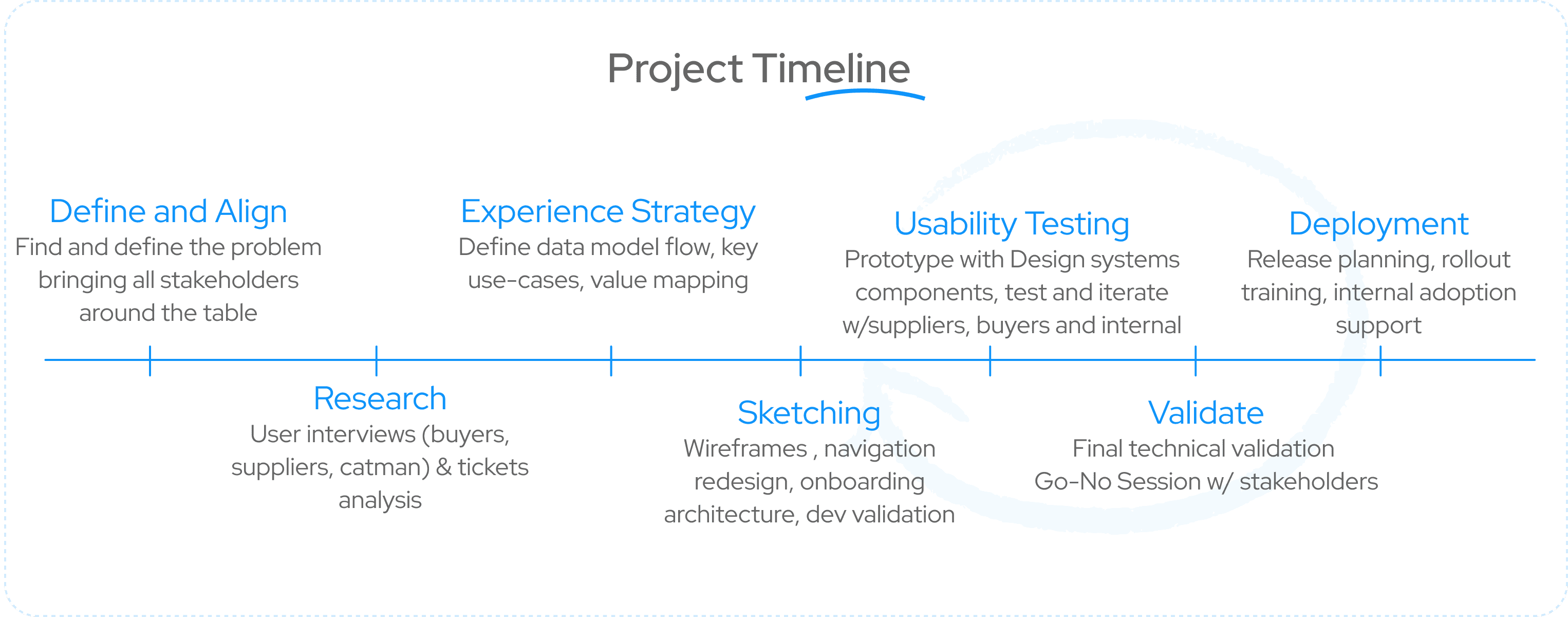
We conducted exploratory research to understand the real-world behaviors, motivations, and frustrations of both suppliers and buyers.

Enables suppliers to manage and validate their business information, while helping buyers quickly find reliable partners based on accurate and trusted data.

Results and Impacts
Thanks to clearer workflows and improved information hierarchy, suppliers were able to understand what information was required and why, which led to more complete and accurate profiles. A more structured data model also made it easier for buyers to evaluate suppliers based on relevant decision criteria, improving trust in the platform.
🚀 Keys outcome
🎯 Suppliers gained autonomy through a self-service dashboard and guidance, reducing dependency on support teams
🎯 Onboarding time decreased by 30% thanks to progressive steps and clearer validation feedback
🎯 Supplier profile completion increased to 87%, improving relevance of search results
Lesson Learned
Data is part of the UX — fixing usability without fixing data structure leads to temporary solutions; defining ownership and data flows was essential.
Ownership increases engagement — suppliers became more collaborative once they had visibility and control over their data.
Simplification wins — breaking onboarding into smaller steps removed friction and improved task completion.
Design must scale — integrating reusable components into the Design System ensured consistency and accelerated delivery.


