Orion
Orion is an AI-assisted operational platform designed to help public service agents manage complex administrative workflows, prioritize urgent cases, and reduce manual processing effort while maintaining transparency and human control.

Duration
12 months (2026)
Tech Stack


Summary
AI-Augmented Operations Platform
ORION is an AI-assisted operational platform designed to help public service agents manage complex administrative workflows, prioritize urgent cases, and reduce manual processing effort while maintaining transparency and human control.
The platform combines workflow management, AI-assisted recommendations, operational dashboards, and explainable decision support to simplify complex operational environments.
I collaborated closely with product stakeholders, operational teams, and developers to define and design the experience from workflow analysis to interface design and testing.
Project Overview
Role: Lead Product Designer UX/UI
Team: Product Owner, Tech Lead, Developers, Operational Experts, Product Designer, AMOA
Domain: Public Sector – AI-Augmented Operational Platform
Responsibilities: Product strategy, UX architecture, dashboard design, AI interaction design, stakeholder alignment, UX delivery
Methods: Workshops, User Interviews, Workflow Mapping, Service Blueprint, Prototyping, Usability Testing, UX Metrics
Problems identified
Operational agents were working across overloaded interfaces, fragmented systems, and repetitive manual validation processes, making workflows difficult to navigate and prioritize efficiently.
The existing experience relied heavily on manual analysis and lacked intelligent assistance mechanisms to support operational decision-making.
Three critical gaps were identified:
Poor visibility across workflow status and dependencies
Limited prioritization of urgent actions and blocked cases
Increasing cognitive load caused by fragmented information and repetitive tasks
Goals
The project aimed to:
simplify complex operational workflows,
improve prioritization and decision visibility,
reduce cognitive overload,
support agents with explainable AI recommendations,
improve operational efficiency while maintaining human validation,
and create a scalable foundation for future AI-assisted services.
🎯 Success Metrics
✔️ Reduce administrative case processing time by 35%
✔️ Increase task completion efficiency by 30%
✔️ Reach a usability satisfaction score above 85%
Research
To better understand operational pain points, workflow complexity, and AI integration opportunities, several research activities were conducted throughout the project, including stakeholder interviews, workshops, workflow mapping, and usability testing.
This research phase resulted in three key deliverables used to structure the platform experience:
AI Opportunity Mapping — identified where AI could improve operational efficiency through intelligent prioritization, AI summaries, anomaly detection, and smart recommendations.
Workflow Diagram — structured approval flows, escalation logic, AI intervention points, and human validation loops across the operational journey.
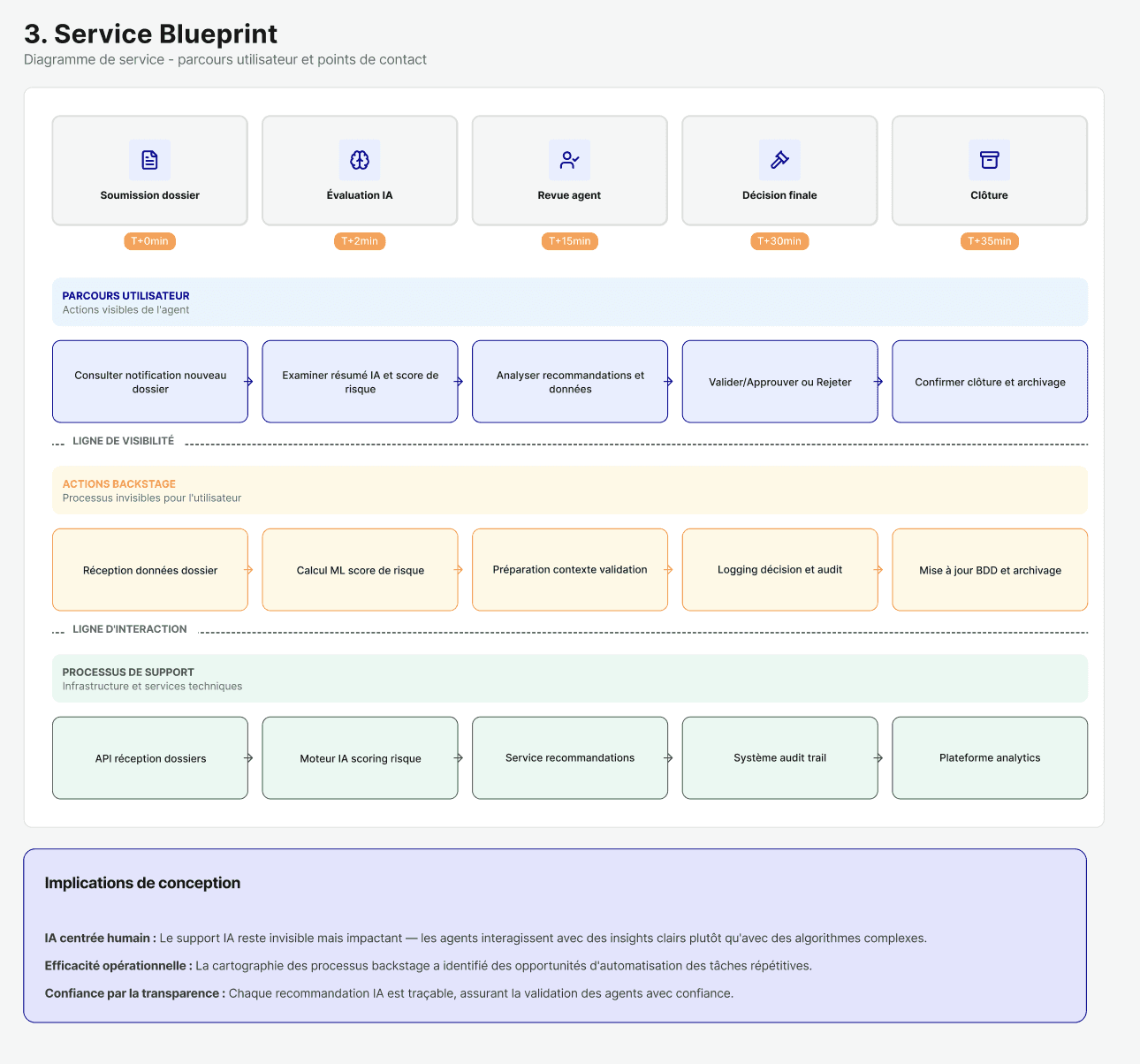
Service Blueprint — mapped the full operational ecosystem by connecting user interactions, backstage processes, technical services, and AI-powered infrastructure.

Essential Features
The prototype brought ORION’s operational ecosystem to life and helped validate how agents navigate complex workflows, review AI-assisted recommendations, and manage administrative decisions before development.
Key Findings
Users struggled with overloaded data tables and poor hierarchy
Critical information was difficult to identify quickly
Operational workflows contained too many hidden dependencies
Manual cross-checking created significant friction
Prioritization mechanisms were insufficient
Users needed clearer guidance and visibility across actions and statuses
These insights helped define both the UX strategy and the AI assistance opportunities integrated into the platform.
Lesson learned
Explainability is critical when integrating AI into operational workflows.
Reducing cognitive load has a direct impact on decision efficiency and user confidence.
Human-centered AI performs best when recommendations remain transparent, contextual, and fully controllable by users.


